Need to reorder Nasal Ranger accessories or sampling supplies? Our online store is now open!

Need to reorder Nasal Ranger accessories or sampling supplies? Our online store is now open!
 AboutLearn more about St. Croix Sensory
 TestingSensory Testing Services – ISO/IEC 17025:2017 Accredited
 TrainingOur Sensory Institute – includes “ODOR SCHOOL”® Training Programs
 EquipmentTools to collect and measure odors
 Nasal RangerNasal Ranger Field Olfactometer
 Art & designLighting, Sound… Now Scent! Action!
 BlogExplore “Top Notes from the Lab”
 LibraryPublications – Media – Case Studies – FAQs
 ContactContact information for our US and Canadian locations
 Online StoreSt. Croix Sensory’s online store for Nasal Ranger accessories, sampling equipment and supplies and Odofin sensory testing kits.
St. Croix Sensory’s Odor Sensitivity Test Kit is utilized to test the noses of potential odour inspectors. The n-butanol odourant pen dilution series provides a standard measure of sensitivity.
It takes approximately 20-minutes to complete the test for one user.
Watch the video to see how the test is administered.
Note: this video was updated in June 2020 with specific precautions for COVID-19.
Test Kit
Dimensions: 17.125 x 13 x 2.25″ (43.5 x 33.0 x 5.7 cm)
Weight: 1.8 lb (0.8 kg)
Individual Pen
Dimensions: Diameter 0.625″ (1.6 cm) Length 5.625″ (14.3 cm)
Weight: 0.5 oz (14g)
Kit Contents:
14 test pens containing n-butanol
2 blank pens
Eye mask blindfold
Gloves for Test Administrator
Test Procedure (you can also print from “Download” section)
Test Data Sheets (you can also print from “Download” section)
Test Record
Serial Number Sticker with Expiration Date
Convenient Test Kit Packaging
Q: What is the shelf-life of the kit?
The odour sensitivity test kit has a 6-month or 50-use shelf life.
Q: What is the odour in the pens?
The odourant pens contain n-butanol at varying dilutuions. Pen #15 is highly diluted that is noticed by only a small percent of the population. Pen #2 is strong n-butanol that is noticed by almost the entire population.
Q: What is a normal testing score?
Studies have shown a normal score in the population is pens 7-9, depending on age.
Odor Sensitivity Test Kit Product Sheet (pdf)
Odor Sensitivity Test Kit – Test Procedure (pdf)
Odor Sensitivity Test Kit – Data Sheets (pdf)
Reference List for Test Administrators (pdf)
How to Administer the Odor Sensitivity Test Kit (video)
Odor Sensitivity Test Kit on Modern Marvels (video)
A Nasal Chemosensory Performance Test for Odor Inspectors (pdf)
A.M. Lay, C.M. McGinley
WEF Odors & Emissions – Bellevue, WA, April 2004

At St. Croix Sensory, we are proud to offer Olfactory Sensitivity Certification and Validation Programs - a comprehensive initiative designed to support organizations interested in strengthening their odour evaluation capabilities through scientifically grounded methods and recognized certification.

The recent A&WMA Odor Management Conference in Bloomington, Minnesota brought together a dynamic community of professionals dedicated to advancing odour science, policy, and best practices. From engaging technical sessions to meaningful networking opportunities, the event underscored the growing importance of effective odour management across industries.
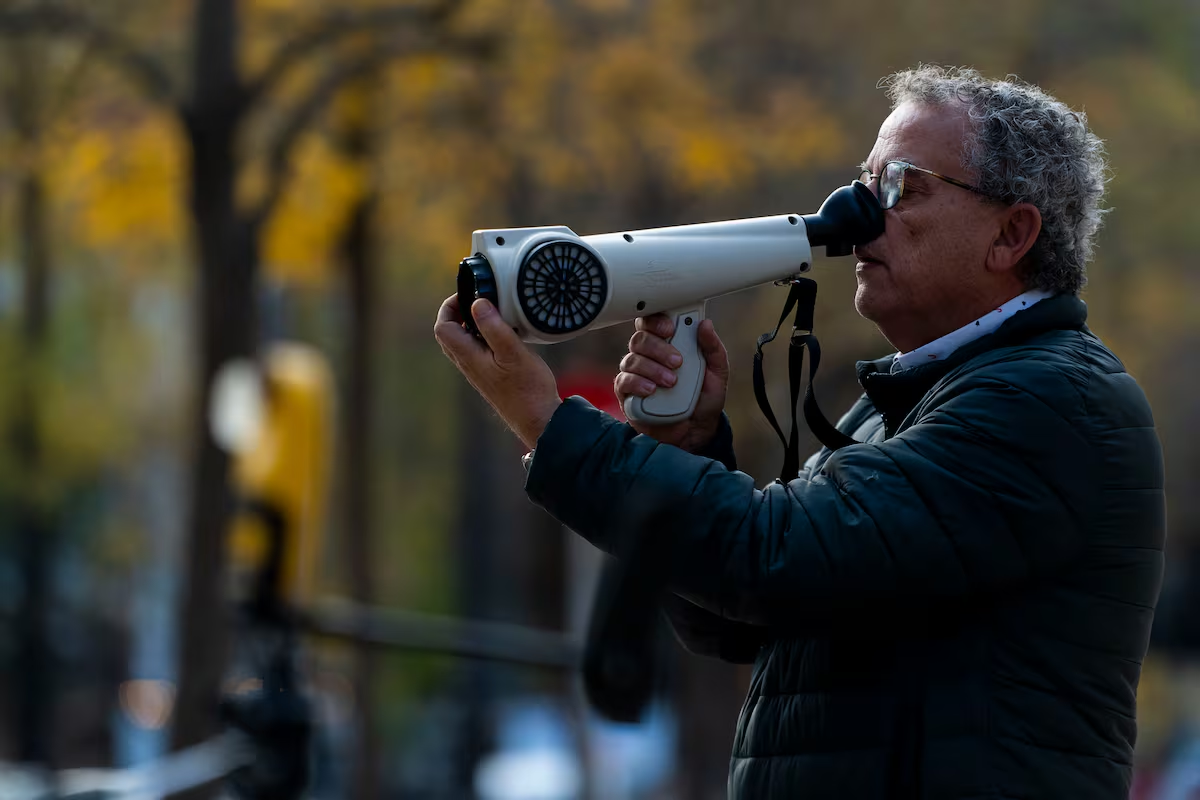
The conversation about air quality in Spain has taken an unexpected and refreshingly human turn. Instead of focusing solely on regulatory limits and mathematical dispersion models, Spain is increasingly asking a simpler question: What does the air actually smell like where people live?

St. Croix Sensory is ISO/IEC 17025:2017 Accredited
